

I still remember the first time someone handed a sales director a Tableau workbook and said, “You don’t need us for this bit anymore.” It was around 2011. Slice by region, filter by product line, drag a pivot table together without waiting three days for a report request to clear the queue ,that was the pitch, and it was a good one. I was the analyst standing next to that workbook, quietly wondering what “this bit anymore” meant for me.
Fifteen years on, I can tell you what it meant. It meant I got a new job title and roughly the same workload.
The tools have been extraordinary, to be fair. Every major visualisation platform since has leaned harder into slice-and-dice ,drag a dimension here, drop a measure there, and a chart appears that would have taken a SQL query and a pivot table to produce a decade earlier. The pitch was always aimed at the same audience: mid-level and senior managers who didn’t want to raise a ticket every time they needed a number. Give them the tool, the thinking went, and the analyst queue drains itself.
It never quite drained. What I’ve watched happen instead, across more organisations than I can count, is that self-service tools got adopted by exactly the people you’d expect ,the analysts. Business users dabbled, built a chart or two, then quietly went back to asking someone in IT or the analytics team to “just pull this together properly.” The self-service layer became another interface between the business and the same people who were doing the pulling before. Usage numbers looked healthy in the rollout deck. Six months in, most managers were opening the tool to view someone else’s dashboard, not to build their own.
Power BI leaned into this promise harder than anyone,a capable product, noticeably more accessible than what came before it, marketed almost entirely on the idea that report-building was now something anyone in the business could do without a developer. And it is more accessible. I don’t think that’s spin. But “anyone can build a report” and “anyone does build a report, correctly, and keeps it correct as the data changes” turned out to be two different claims, and only one of them got tested at scale. The gap between those two claims is where most of the IT tickets still live.
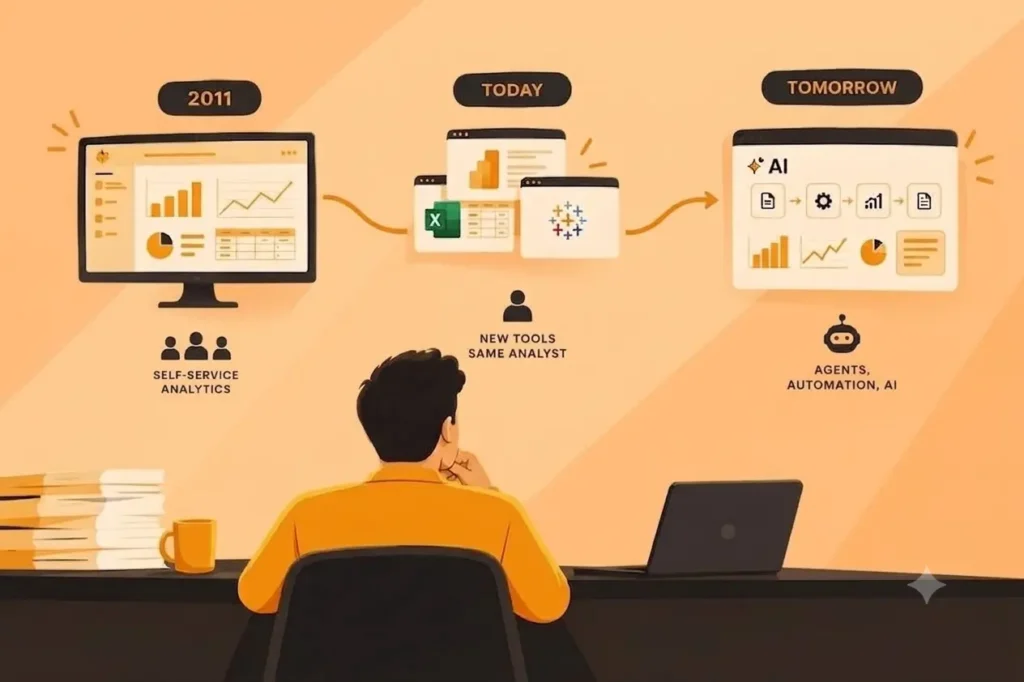
Meanwhile, the tool nobody planned around quietly won. Excel never left. Analysts still build the real analysis in a spreadsheet, still pivot the way they always have, and still put a deck together by screenshotting ,sorry, “sniping” ,a chart out of Excel and pasting it into PowerPoint. I’ve done this myself more times this year than I’d like to admit, on a platform I helped build specifically so people wouldn’t have to. Old habits aren’t just hard to break; sometimes they’re still the fastest way to get something out the door by 5pm.
Now Copilot has arrived to pull Excel users in even further rather than out,clean this range, summarise this table, write me a formula ,and it’s good at it, which is exactly why it’s dangerous to the old promise. It doesn’t ask anyone to leave Excel and learn a new tool. It makes the tool people already love more capable, which means the platform that self-service analytics was supposed to retire is now getting reinforced by the same wave of AI that’s meant to replace it.
Every tool claims to support Google Ads, Meta Ads, and LinkedIn Ads. Confirm the integrations are native, meaning the tool’s own team built and maintains the connection through each platform’s official API. Third-party plugin connectors break every time an ad platform updates its API. Native integrations survive those updates.
And that’s where the promise has quietly shifted again, without anyone announcing it. The hope now isn’t that a manager builds their own Power BI report. It’s that an AI agent takes a messy export, cleans it, models it, builds the dashboard, and drafts the deck ,the whole chain, unattended. I’ve had this conversation with three different teams in the last two months, all circling the same idea: point an agent at the data on Monday morning, have a reviewed report by Monday lunch, no analyst in between.
I want that to work. I’m building toward pieces of it. But I keep landing on the same question every time, and it’s not a new question ,it’s the same one that self-service tools never really answered, just moved further downstream. If an agent cleans the data, models it, and writes the narrative, who looks at the output before it reaches someone making a decision on it? Not “who could,” in theory ,who actually will, at 8:45am, before the number goes into the board pack?
Fifteen years of self-service tooling didn’t remove the analyst. It moved them from building the first draft to checking everyone else’s. Maybe that was always the real job. I’m not sure yet whether the next wave of AI agents finishes that handover for good, or just adds one more layer for someone to validate before it lands in front of a decision-maker.
If you’ve watched this shift from either side,as the analyst or as the manager who finally got their own dashboard,I’d like to know which one it felt like to you.
