

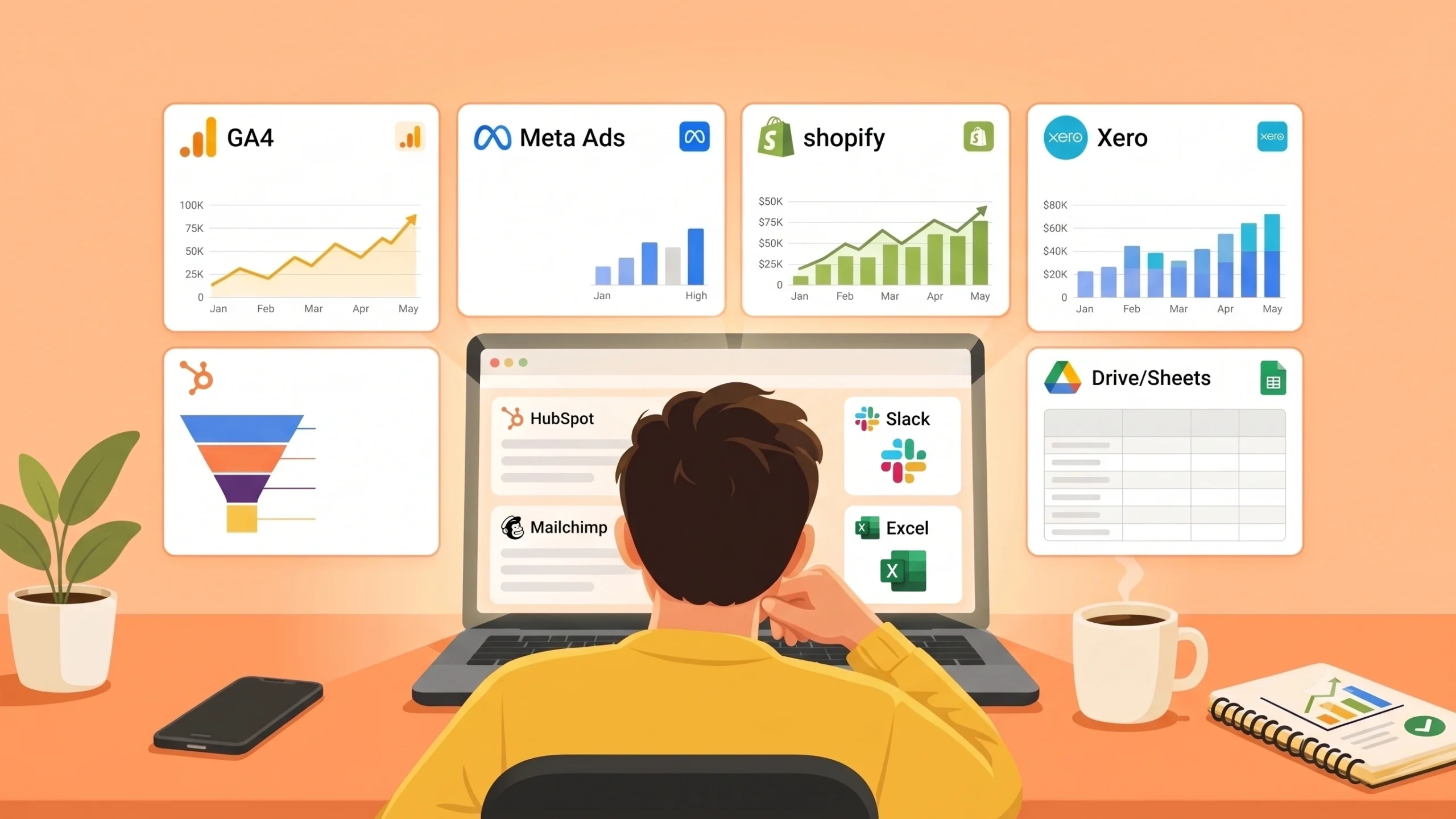
Picture a Monday morning. Coffee’s still too hot to drink. And there, across the top of the screen, sit fourteen browser tabs: GA4 for what happened on the website over the weekend, Meta for how the ad spend did, Shopify for whether anyone actually bought anything, and Xero to see if the bank balance agrees with any of it. Four different logins, four different date pickers, four different definitions of what “this week” even means. By the time all four numbers are in one head, it’s nearly lunch, and somehow nobody’s confident the numbers agree with each other anyway.
I’ve sat across the table from that exact Monday morning more times than I can count, in businesses that had nothing else in common — a dairy producer, a freight operator, a boutique retailer. Different industries, same tabs.
Why so many apps in the first place?
Here’s the thing worth saying plainly: this isn’t a mistake anyone made. A small business subscribing to GA4, Meta, Shopify, and Xero separately isn’t being disorganized — it’s being smart. Each of those tools is genuinely the best in its category at a price point a small business can actually justify. Nobody’s going to tell a boutique retailer to drop Shopify for a bespoke commerce platform just to get unified reporting. The fragmentation isn’t a mistake. It’s the entirely rational result of good individual decisions.
Every app tells its own story. Nobody tells the whole one.
Each of those tools will happily show you its own version of success. GA4 will tell you traffic is up. Meta or whatever PPC reporting tool will tell you the cost-per-click is down . Shopify will tell you units sold. Xero will tell you what landed in the bank. What none of them will tell you is whether the traffic *caused* the sales, whether the ad spend was worth the margin it produced, or whether “a good week” on the marketing dashboard was a good week for the business.
And here’s the part I think gets missed: those apps aren’t broken, and they’re not badly designed. They were built to run the transaction to serve the ad, to process the order, and to reconcile the invoice. They were never built to give you the bird’s-eye view, because that was never their job. This is just as true for the enterprise as it is for small businesses. The difference isn’t that big companies have solved this; it’s that they can throw resources at the symptoms. The large enterprise buys proper BI. The mid-size business cobbles together a consolidated report with a spreadsheet and a spare afternoon of someone’s time each month. The aspiring small business? They just live with the tabs and quietly wonder why nobody built them a single view.
Enter our AI friend, sort of
“Ah,” says the AI-optimist in the room, “this was a problem two years ago. We have AI now just ask it to pull everything together.” Fair point, and I don’t disagree with instinct. But try it, and you hit the same wall almost immediately: I still must hand out the AI the data myself, one export at a time, from four systems that have never spoken to each other. The AI is very good at making sense of data once it has it. It’s not yet magically inside your Shopify account uninvited.
“No problem,” comes the next answer, “we’ll build you an agent that goes and collects it all for you.” Now that’s genuinely interesting, an agent that logs in everywhere, pulls what’s needed, and hands it over automatically. I like this idea. I just have some very ordinary follow-up question;
Where does all this actually live?
Where is the agent putting all that data once it’s collected? My laptop? That’s fine until I want my ops manager and my accountant to see the same numbers I’m seeing — at which point “my local machine” stops being a data platform and starts being a bottleneck with my name on it. And where does the AI-generated output live so my team can open it Monday morning without me forwarding a screenshot?
At which point, someone in the room usually says, half-joking, “sounds like you’ve got yourself an enterprise problem now maybe hire some consultants?” Which is funny, except it’s also not entirely wrong, and that’s the uncomfortable bit.
The part that actually matters
Because here’s what I think this whole exercise reveals: the real value was never the AI generating a pretty chart at the end. It’s the unglamorous middle consolidating the data into one place, with meaningful relationships between GA4 sessions, Meta spend, Shopify orders, and Xero revenue, so that a question like “was this month profitable” has one answer instead of four. AI can do genuinely remarkable things with that kind of unified, well-connected data. But it still needs feeding, orchestrating, and somewhere to live — and that’s infrastructure, not a prompt.
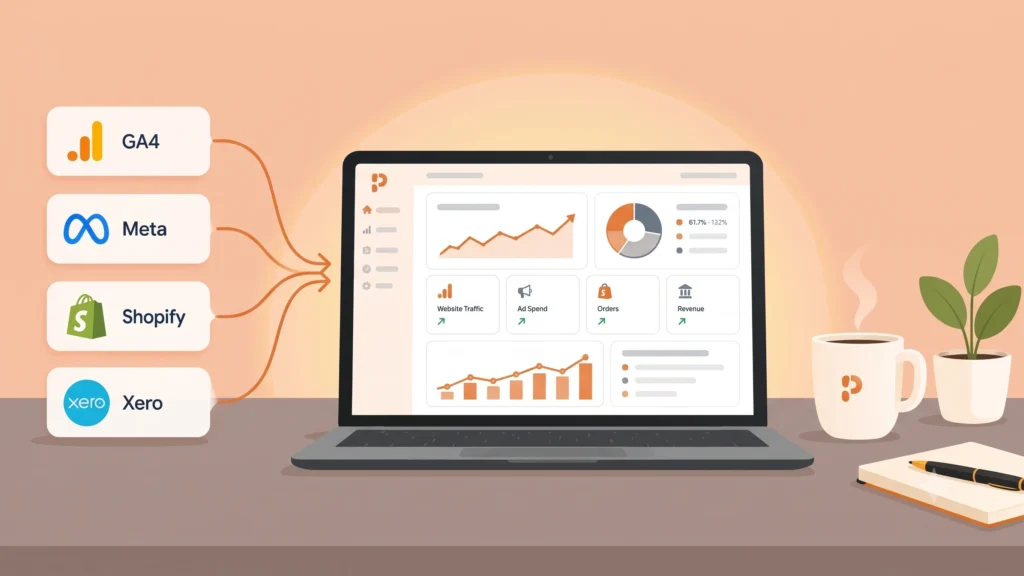
This is what BI as a service is: the feeding, orchestrating, and hosting handled by someone else, so the unified view shows without a business having to build a data team to get it.
So here’s the honest question I keep sitting with, if proper AI-driven reporting needs feeding, orchestration, and hosting to actually work — who exactly is supposed to build and pay for that for a business too small for an enterprise IT budget, and too busy running the shop to build it themselves?
